Capacity expansion modeling
Where battery storage should go
Letting each province choose its own storage strategy is always cheapest, but lowest cost and lowest emissions are not the same strategy.
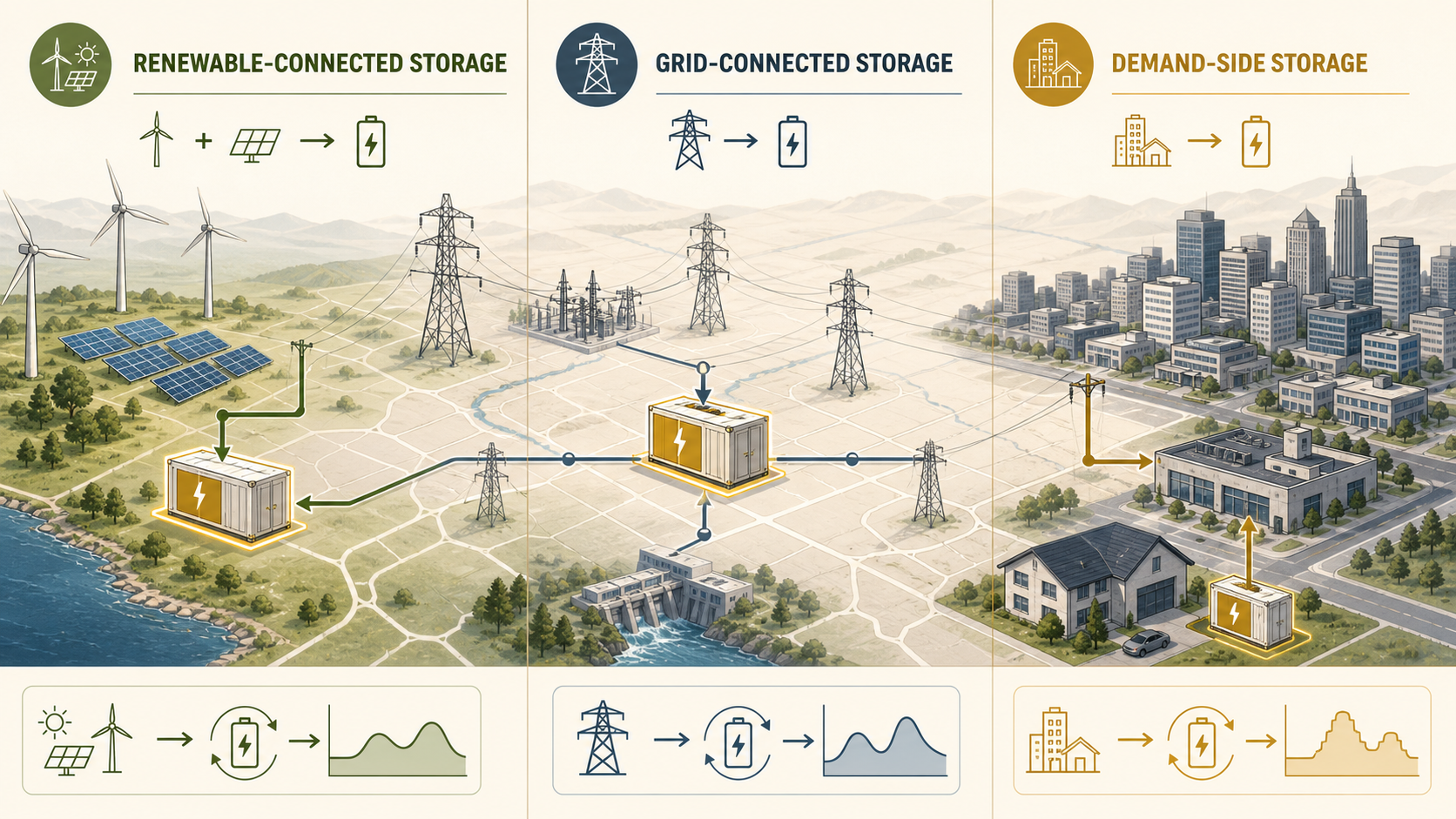
Cover illustration generated with AI
Published finding
Storage value depends on where it connects
Cost-optimal does not mean emissions-optimal. Renewable-connected storage gives the lowest CO₂ emissions at low carbon prices; the provincial mix reaches the lowest emissions only when the carbon price is 66× the low-price case.
Power system modeling, PhD work. Published in Nature Communications, 2023.
The problem
Storage is treated as a single decision in most planning studies: how much to build. Where it sits on the system, and who it is built to serve, is left to the market or assumed uniform. That assumption is expensive in a country where one province has abundant wind and another has almost none, because the storage that helps the first is not the storage that helps the second.
What I did
I extended SWITCH-China, an hourly capacity expansion and dispatch model, to compare three nationally uniform battery deployment strategies, renewable-connected, grid-connected, and demand-side, against a heterogeneous strategy in which each province chooses freely among them. The comparison runs across a range of carbon prices, so cost and emissions outcomes can be separated rather than reported as one score.
What I found
The heterogeneous strategy always delivers the lowest system cost, and the pattern behind it is clean: provinces with abundant renewable resources adopt renewable-connected batteries, while provinces with limited renewables adopt demand-side batteries. Lowest cost and lowest emissions, however, are not the same strategy. Renewable-connected storage achieves the lowest CO2 emissions when carbon prices are low, and the heterogeneous strategy only reaches lowest emissions at extremely high carbon prices. A national storage mandate written for cost will therefore not deliver the emission outcome its authors expect, and the gap between the two is a policy choice worth making explicitly.
Limits
The model represents provinces and interprovincial transmission, not distribution networks, so the demand-side case is treated at an aggregate level. Battery costs are exogenous projections.